|
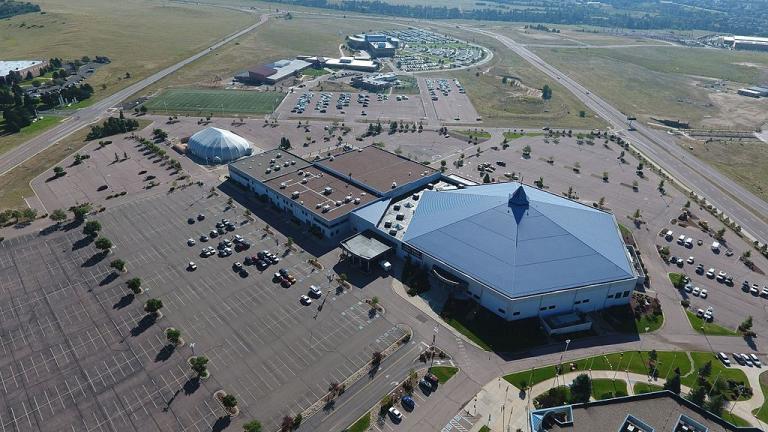
So I was surprised to learn that New Life Church, a nondenominational, charismatic evangelical megachurch in Colorado Springs, with more than 10,000 members, recently embraced more traditional liturgies as well as social justice work without evangelization. New Life now recites the Nicene Creed, which it uses as its statement of faith, offers Communion at most of its locations on Sunday mornings, teaches its members about the liturgical calendar and has a home for unwed mothers experiencing homelessness called Mary’s House—as in Mary, the Mother of God.
New Life Downtown now concludes its Sunday service with a beautiful a capella rendition of an Anglican Doxology, a hymn of praise to the Trinity. Doxologies are found in eucharistic prayers and Catholic devotions like novenas and the rosary, time out of mind, but when was the last time you heard a doxology sung in a Roman Catholic church? In practice, many Roman Catholic churches have become increasingly low church.
“From the first moment I walked into the auditorium I felt welcomed and valued. It’s really chill.”
These changes are noteworthy because New Life is one of the most important megachurches in the United States. In its 34-year history, New Life has been a visible and politically active congregation embracing nationalism and the prosperity gospel and hosting celebrity preachers like Benny Hinn. Its founding pastor, Ted Haggard, was once an adviser to President George W. Bush. President Bush Skyped in to speak at New Life services from the White House. Pastor Haggard served as the head of the National Association of Evangelicals. (After a scandal, he resigned in 2006 and is no longer affiliated with New Life.)

So what is happening at New Life is noteworthy. More intriguing yet, it is happening at evangelical megachurches and formerly iconoclastic mainline churches all across the country. Whether it is a move of the Holy Spirit toward greater unity or cultural appropriation on a massive scale, old school Catholic practices are in. Yes, that celebrity Protestant pastor is wearing a stole with Our Lady of Guadalupe on it.
New Life, at its roots, is a “seeker-friendly” church, visible from the interstate, aggressively casual and extraordinarily welcoming. A woman tells me: “From the first moment I walked into the auditorium I felt welcomed and valued. It’s really chill.” A big screen in the auditorium says, “You look great this morning. We’re glad you joined us.☺”
People come and go during services or watch them on their laptops at home. You can bring your coffee into the auditorium. One Sunday morning, I watched as two friends took a selfie and uploaded it to Instagram during the service.
Before the turn toward more traditional liturgical practices in 2012, the typical worship experience consisted in about an hour and half of upbeat praise and worship music, announcements and a collection, a sermon on a Scripture passage picked at random, more praise and worship music, and then some kind of altar call, an opportunity to come up and be prayed over by a small team. The services were nonliturgical and nontraditional, more focused on what pastors feel the Holy Spirit is doing now than on church history, theology or formation by ancient ritual gestures like kneeling or the sign of the cross.
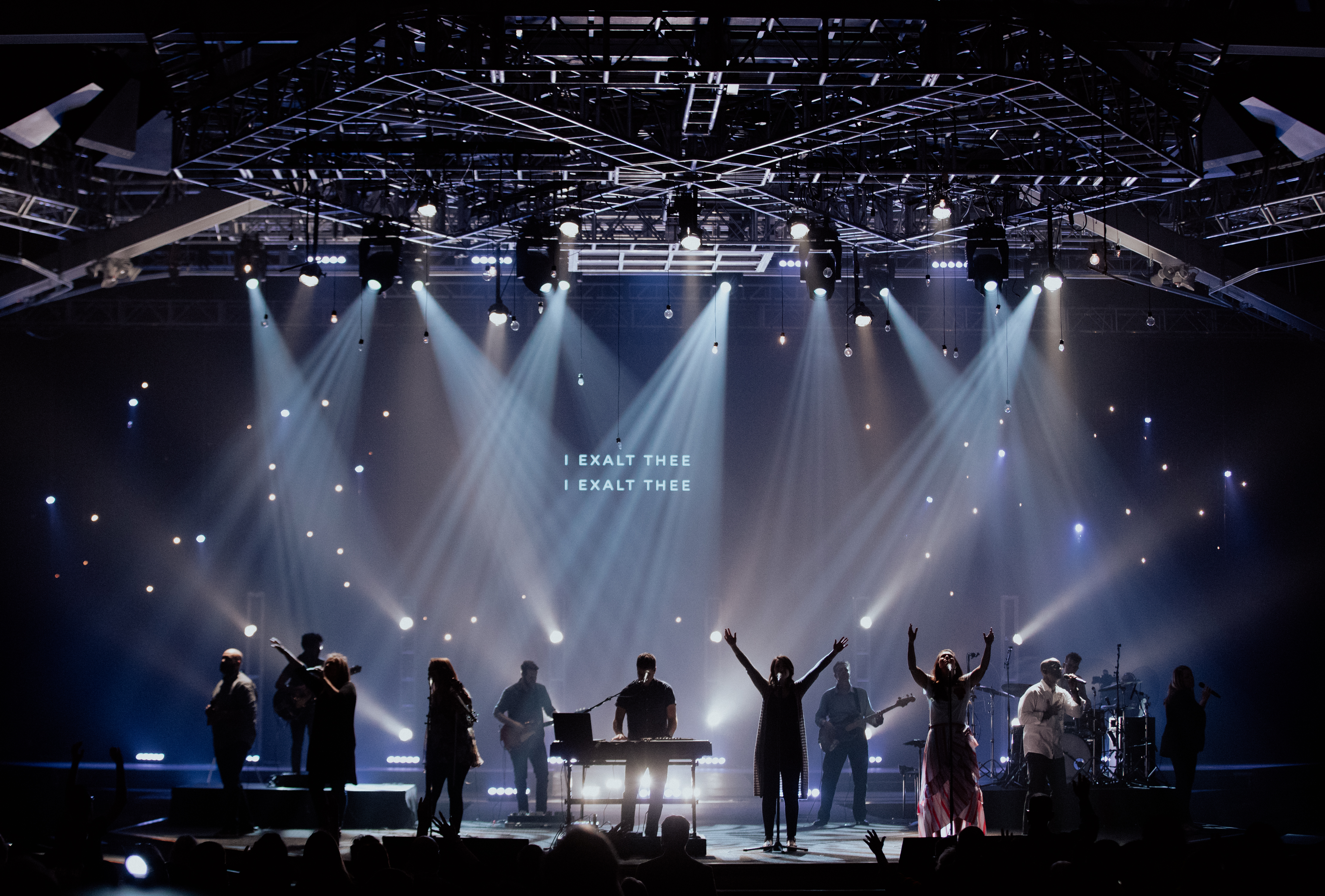
For decades, the appeal of a charismatic style of worship was strong, and these churches grew at astonishing rates. Who does not long to feel welcomed and loved and to experience the Holy Spirit in a life-changing way? I went to a revival at New Life when I was in middle school and found it powerful. A woman preached. That alone made a huge impression on me as a Catholic girl. It was dark in the auditorium, and there was a smoke machine and a worship band and hundreds of kids holding up their hands, saying the name of Jesus and crying.
Positive, Uplifting and Relevant
Megachurches are typically known for their concert-like worship experiences, lasers, smoke machines, espresso bars, worship bands full of young cool people and a pastor in jeans and T-shirt preaching on short passages of Scripture in a way that is positive, uplifting and immediately relevant to everyday life. There is much there that is appealing to worshipers, so why make a change now?
Historically, much of what is popularly considered charismatic megachurch worship has its roots in Pentecostalism, a 20th-century movement indigenous to the United States. In 1906, led by William J. Seymor in Los Angeles, members of the Azusa Street Revival began speaking in tongues. The idea that the Holy Spirit frequently speaks directly to and through individuals helped launched the Pentecostal movement.
Differences exist among the various groups, but typically this strand of evangelical Christianity adopts a version of sola scriptura, albeit a version that many of the early reformers would not recognize, combined with the gift of tongues as its starting place. George Marsden argues in his history, Fundamentalism and American Culture, that the goal was to “set aside all intervening tradition and return to the purity of New Testament practice. The Bible alone should be one’s guide.... The individual stood alone before God.” No creed but the Bible. This despite the fact that the New Testament canon was not fully compiled until almost 400 years after the death of Jesus.
"In megachurches, and smaller Bible churches, Scripture is understood as inspired and without error."
In megachurches and smaller Bible churches, Scripture is understood as inspired and without error. It is the final authority and the rule of faith. The Bible alone suffices and stands in direct opposition to any sort of human authority (like the church fathers or tradition) that does not arise from the Holy Spirit speaking directly to an individual with a message that can be confirmed in Scripture. The first line of the statement of faith of the National Association of Evangelicals reads, “We believe the Bible to be inspired, the only infallible, authoritative word of God.” They believe that ancient ritual gestures, sacraments and rote prayers like the rosary get in the way at best. At worst, they are idols to be despised.
Acceptance into the faith does not require baptism but rather a simple admission of faith. When I was in high school, street preachers told me: “The Bible is the word of God. Jesus is the Son of God. And if you accept him as your personal savior, your salvation is 100 percent assured.” It felt like an Amway pitch. I could get saved right on the sidewalk before sixth period—no long, boring catechumenate required.
This concept of an individual with a Bible who stands alone before God versus a person who needs a church and practices to help mediate God’s grace, represents a deep and real divide that has consequences for how evangelicals see themselves relative to more traditional groups. As recently as 2006, Wheaton College, the most prestigious evangelical college in America, fired Professor Joshua Hochschild for being received into the Roman Catholic Church.
As a result of these historical differences, as well as those I experienced personally, I was fascinated when I walked into New Life Downtown and the pastor, wearing faded jeans, was standing behind an altar with his hands elevated saying a version of a eucharistic prayer. Pentecostalism has its own embodied spiritual practices, but receiving the “body and blood” of Christ, as Jesus instructed on the night before he died, has not typically been at the top of the list.
Simon Scionka, a former evangelical youth minister, left his megachurch for the Orthodox Church of America, in which he is now a deacon. “When I was growing up we had a Communion service twice a year,” he says. “It wasn’t seen as important.” Grape juice and crackers in individual plastic cups. No penitential act. No eucharistic prayer. No “Behold the Lamb of God.”
A Move Toward Tradition
New Life is not alone in its shift toward more traditional worship. The Village Church, a Southern Baptist megachurch in Flower Mound, Tex., with more than 14,000 members, has Matt Chandler as its pastor. His sermon, distributed by podcast, is frequently one of the top three Christian podcasts on iTunes. Southern Baptists have been historically antiritual, antiliturgical and even anti-Catholic. When I was growing up, Southern Baptists defined themselves in many ways in opposition to Rome. Today, The Village Church observes a liturgical calendar (Advent, Christmas, Epiphany, Lent, Easter, Pentecost), recites the Apostles’ Creed and fasts during Lent.
“When I was growing up we had a communion service twice a year. It wasn’t seen as important.”
Willow Creek, a megachurch near Chicago with more than 24,000 members, now offers a traditional liturgical-style service. Mars Hill, founded by Rob Bell in Grand Rapids, Mich., in 1999, has subsequently rediscovered the Nicene Creed, the church calendar and the importance of weekly Communion. It has also decided to limit the special effects. In its sanctuary, a former shopping mall, there is now a homemade wooden cross and an altar with altar cloths that are changed to match the color of the liturgical seasons. New Life in Colorado Springs has also scaled back, even returning to a parish model. It now has six locations in addition to its main campus. The Rev. Glenn Packiam, the pastor of New Life Downtown, tells me, “Not everyone wants to come to a giant building on Sundays.”
Epiphany Church, a megachurch in the Dallas/Fort Worth, Tex., area, uses incense and candles every week, picks its readings from the Revised Common Lectionary and has its members recite ancient prayers in unison and from memory. After Scripture readings you hear, “The Word of the Lord” and “Thanks be to God.”
Why Now?
For many reasons, these Christians are not, to paraphrase Blessed John Henry Newman, getting deep into history and ceasing to be Protestant. So why is this evangelical ressourcement happening? Why are megachurches and formerly iconoclastic mainline denominations looking more like Catholic parishes in terms of liturgy and practices even as some Catholics are, late to the party as usual, imitating evangelicals and building churches with big screens that look more like suburban dentist’s offices than places where heaven and earth kiss.
In some instances, it is the fruit of sincere conversion. For some megachurch pastors, the move toward liturgy and tradition is about a desire to go deeper in forming their congregations in faith. Pastor Packiam’s office is full of books I recognize: N. T. Wright, James Martin, S.J., the Anglican Book of Common Prayer. As he speaks, I cannot help but wish Pastor Packiam was a Catholic deacon or priest. He is kind, intelligent, passionate about his faith and gracious with his time. Pastor Packiam played the decisive role in bringing old things, like a Good Friday service that ends in silence, to New Life.
Pastor Packiam’s desire for something deeper came from a painful period in New Life’s history. After Pastor Haggard’s fall from grace in 2006, Pastor Packiam says, “I became concerned about the way evangelical worship highlighted an individual at the center of it all”—the celebrity pastor. He began reading books by authors like Henri Nouwen and Eugene Peterson, “I realized that something was missing in our worship; and that something was Eucharist, was sacramentality.” He looked at Anglican, Orthodox and Presbyterian churches but decided to stay and help his congregation “resource from the tradition.” For him, “This is a move of the Spirit toward theological depth and historicity.”
For others, it is about survival. Megachurches are big businesses with lots of people on payroll, and part of the change is about marketing, rebranding, consumer choice and retention. You want a contemporary service? We offer that. You want traditional? We have that too.
Pastor Packiam says, “Downtown is where people have fled to get away from evangelicalism. So New Life Downtown tends to attract people who may be burned out on some of the shallowness of church services that don’t connect to theology. When we do the Nicene Creed, it’s tethered to history; it says, ‘We’re not making this stuff up....’ When we say, ‘Behold the lamb of God who takes away the sins of the world,’ that moves people.”
“I realized that something was missing in our worship and that something was Eucharist, was sacramentality.”
People can be entertained on devices 24 hours a day; they do not need a church for that. They need a church for silence, reverence, community, ancient wisdom, the opportunity to be of service, the real presence of God. Megachurches have realized that many are leaving to find that elsewhere.
Eighty percent of the congregation of Holy Theophany Orthodox Church, also in Colorado Springs, are converts from evangelical and Protestant backgrounds. Their priest, the Rev. Anthony Karbo, became a Christian through participation in Young Life, a national evangelical youth organization headquartered in Colorado Springs. He says, “As a Protestant I met Christ. In the Orthodox Church I met the rest of his family, including his mother.” Orthodoxy both challenges and appeals because its liturgy has not changed much since the fourth century and neither have its teachings. Unlike the Catholic Church, it has not tried to seem less pagan, less foreign, less strange. It has stayed weird.
Eric Jewett, a deacon in the Orthodox Church and a former Free Methodist youth pastor, says, “In the ancient church I encountered the fullness of the faith as it had been lived and preserved since the time of Christ and his apostles.”
Deacon Scionka, the former evangelical youth minister, describes falling in love with their style of worship: “My background is Bible-centered, which led to me think that liturgical worship was extra-biblical, but in reality it’s very biblical. The whole service is scriptural, and it centers on our unity in Christ. It floored me.” He tears up describing his first Christmas in the Orthodox Church.
“At the end of the Nativity Vigil, this long beautiful candlelight service, it hit me that this was the first time in my life that I had gone to church for Christmas and it was really celebrating the birth of Christ,” he said. “No big performances. No distractions. Just a dark, beautiful, candlelight service all about Christ.”
Some former evangelicals used vibrant seeker churches as a stepping stone, eventually leaving for Orthodox, Anglican or Presbyterian communions. For many, leaving evangelicalism for Catholicism would mean losing careers, even family and friends. Ken Craycraft, a theologian who was received into the Catholic Church from a Church of Christ background, says, “In certain segments of American evangelicalism, including the Church of Christ, becoming Catholic is worse than becoming an atheist, and I say that without irony because, not only are you saying you’ve renounced belief; you’re embracing evil, you’re embracing the anti-Christ described in Revelation.”
this article even considered Catholicism. In part, this was because of doctrine. Mary and popes remain oddities to many. In part, it was because of the crisis of sexual abuse by members of the clergy. And despite the interest in some Catholic traditions, many felt our Masses and parish life still were not compelling.
It is easy to find both Catholics and Protestants who are starving for something less shallow, more challenging and more embodied than the typical American experience of faith. Many Catholic parishes, too, could benefit from a renewed interest in the sacred art, music and architecture that have shaped the Catholic imagination for millennia. As the Catholic Church continues to work to keep people in and attract people to the faith, it would do well to remember that the pull of tradition can be an attractive one, even or perhaps especially for the millennial generation, which is famously interested in old things, from record collecting to jarring pickles. If evangelical and “next generation” worship have been, in part, about making church cool, ironically, there is nothing cooler than a first edition, and the Catholic Church is about as vintage as you can get.
This article also appeared in print, under the headline “New Life Goes Old School: Why Megachurches Are Embracing (Some) Catholic Traditions,” in the May 13, 2019, issue.
More: ECUMENISM